

ALIBARBAR INGOT 9000 e-liquid
ALIBARBAR INGOT 9000 Battery vs E-Liquid: Which One Runs Out First?
The ALIBARBAR INGOT 9000 is marketed as a high-capacity disposable device with a built-in battery, a large prefilled e-liquid chamber and an electronic display showing estimated battery and liquid levels.
One of the most common questions about the device is simple:
Does the ALIBARBAR INGOT 9000 battery run out before the e-liquid, or does the e-liquid finish first?
There is no universal answer. In normal operation, the battery and e-liquid are intended to support the same overall product lifespan. However, individual usage patterns, draw length, storage conditions, leakage, battery degradation and manufacturing variation can cause one to reach its limit before the other.
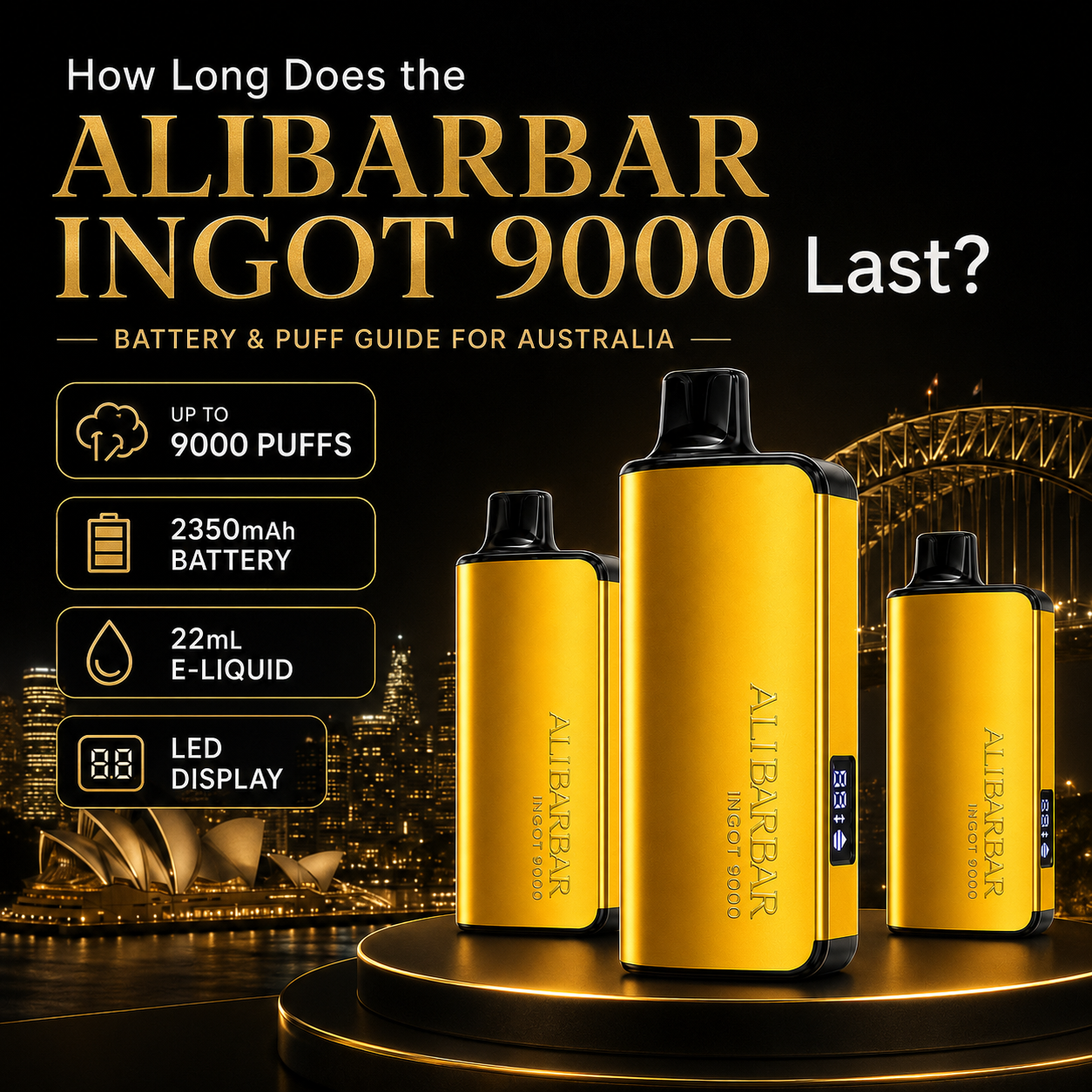
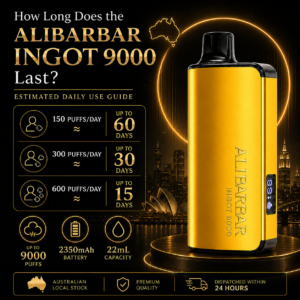
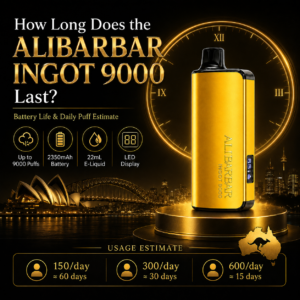
According to the published ALIBARBAR product specifications, the INGOT 9000 contains a 2,350mAh non-rechargeable battery, 22mL of e-liquid, a 1.2-ohm coil and an LED display for monitoring estimated battery and e-liquid levels. The manufacturer advertises a maximum of up to 9,000 puffs.
Australian notice: This article is provided for general product, safety and regulatory information. Nicotine is addictive, and vaping is not risk-free.
Quick Answer
For a correctly functioning ALIBARBAR INGOT 9000, the battery and e-liquid should theoretically decline at a broadly similar rate.
In real-world use:
- The battery may run out first when the unit has been stored for a long time, exposed to extreme temperatures or affected by battery degradation.
- The e-liquid may run out first when the user takes longer draws, uses the device frequently or the unit has experienced leakage.
- Both may appear low at approximately the same time when the device performs according to its intended design.
Because the INGOT 9000 is listed as non-rechargeable and sealed, reaching the end of either resource effectively ends the device’s usable life.
ALIBARBAR INGOT 9000 Specifications
| Feature | Published specification |
|---|---|
| Advertised maximum | Up to 9,000 puffs |
| Battery capacity | 2,350mAh |
| E-liquid capacity | 22mL |
| Charging | Non-rechargeable |
| Coil resistance | 1.2Ω |
| Display | Battery and e-liquid indicators |
| Dimensions | 103 × 40 × 26mm |
| Net weight | Approximately 90g |
| Exterior | Curved gold-coloured casing |
These are manufacturer-published specifications rather than independently verified Australian laboratory results.
Understanding the Battery and E-Liquid Relationship
The battery and e-liquid perform different roles.
The battery supplies electrical energy to the heating coil. The coil then heats a small quantity of liquid each time the device activates.
Every draw therefore consumes:
- A portion of the available battery energy
- A portion of the available e-liquid
If every activation were identical, battery and liquid consumption would be relatively predictable. In practice, draws vary in duration and intensity, making exact comparisons difficult.
A five-second draw generally places a different demand on the battery and liquid supply than a brief one-second draw. This is one reason why an advertised puff count cannot predict the exact number of calendar days that a device will last.
Theoretical Consumption per Puff
Using the manufacturer’s maximum claim, a simple mathematical calculation can provide context.
ALIBARBAR INGOT 9000 e-liquid
E-liquid calculation
22mL ÷ 9,000 puffs = approximately 0.0024mL per puff
This is approximately 2.4 microlitres per puff.
Battery calculation
2,350mAh ÷ 9,000 puffs = approximately 0.26mAh per puff
These figures are only theoretical averages. They do not account for:
- Different draw lengths
- Power loss
- Battery efficiency
- Coil behaviour
- Remaining unusable liquid
- Activation circuitry
- Storage-related battery discharge
- Differences between individual units
The two numbers also cannot be directly compared because millilitres measure liquid volume while milliamp-hours measure electrical charge.
When Does the Battery Run Out First?
The INGOT 9000 battery may reach its operating limit while the display still suggests that some liquid remains.
Several factors can contribute to this.
Long-term storage
Lithium batteries gradually lose charge during storage, even when a device is not actively used.
A product that has remained in storage for an extended period may begin with less usable battery energy than a recently manufactured unit.
Exposure to excessive heat
Australian summer temperatures can become extremely high, especially inside parked vehicles or in direct sunlight.
Heat can affect lithium-battery performance and may create a safety risk. A vape should not be left inside a hot car, near a heater or in direct sun.
Stop using any unit that becomes swollen, unusually hot or deformed.
Cold conditions
Very cold temperatures can temporarily reduce battery performance and voltage output.
The device may appear weak or stop activating normally even though its e-liquid indicator is not empty.
Frequent short activations
Repeated activation throughout the day can place continued demand on the circuitry and battery.
Even when each individual draw is short, high-frequency use may reduce the number of days before the available battery power is exhausted.
Battery or circuitry fault
A damaged battery, activation sensor or internal electrical connection may cause the device to stop working before its liquid supply is depleted.
This is a device fault rather than evidence that the liquid has been fully used.
Signs That the Battery Is Running Out
Possible battery-related signs include:
- The battery indicator displays a very low level.
- The LED display flashes when the user attempts to activate the device.
- Vapour output becomes weak despite the liquid indicator showing remaining liquid.
- The device activates intermittently.
- The screen no longer turns on.
- The device stops responding completely.
The standard published version is non-rechargeable. It should not be opened, modified or connected to unofficial charging equipment.
A non-functioning device should not be punctured or dismantled to access the remaining liquid.
When Does the E-Liquid Run Out First?
The liquid supply may become depleted while the battery indicator still shows available power.
This may occur for several reasons.
Longer draws
Longer activations generally heat the coil for more time and can vaporise more liquid per draw.
A person taking long draws may therefore consume the 22mL supply in fewer than the advertised maximum number of puffs.
Frequent or continuous use
Using the device repeatedly without allowing it to rest may increase liquid consumption and heat around the coil.
This can also affect flavour consistency.
Leakage
Liquid lost through the mouthpiece, airflow channel or device seams is no longer available for normal use.
A leaking unit may therefore reach an apparently empty state earlier than expected.
Do not continue using a device with significant leakage, especially when liquid reaches the display, casing seams or mouthpiece.
Coil saturation differences
The amount of liquid delivered to the coil may vary during use.
If the coil draws more liquid during longer or stronger activations, the liquid supply may decline faster than a simple puff-count calculation suggests.
Product variation
Small differences between devices, batches and internal components may affect the relationship between battery use and liquid consumption.
Signs That the E-Liquid Is Running Out
Possible signs include:
- The e-liquid indicator is close to empty.
- Flavour becomes noticeably weaker.
- Vapour production declines while the battery level remains available.
- The draw feels unusually dry.
- The device develops a burnt or overheated taste.
- The liquid display stops decreasing normally or appears inconsistent.
A burnt, metallic or chemical taste should not be ignored.
Continuing to use a device after the liquid is depleted can overheat the wick or coil. Stop using it rather than attempting to obtain the final advertised puffs.
What Does the LED Display Show?
The INGOT 9000 includes a side-mounted electronic display designed to provide feedback on:
- Remaining battery power
- Estimated e-liquid level
ALIBARBAR identifies this screen as one of the principal features of the INGOT range. The published product information says users can check battery level and e-liquid usage during operation.
The display provides useful guidance, but it should not be interpreted as a precision measuring instrument.
For example, a display reading of 25% does not necessarily guarantee that exactly 5.5mL of liquid or 2,250 puffs remain.
The values may be estimated using voltage, activation time or other internal measurements rather than directly measuring the exact amount of liquid in the chamber.
Why the Two Indicators May Not Decline Equally
Users may notice that one indicator decreases faster than the other.
This does not automatically mean the device is defective.
Battery drops faster than liquid
Possible explanations include:
- Battery ageing
- High or low storage temperatures
- Frequent activation
- Internal electrical inefficiency
- Voltage decline near the end of battery life
ALIBARBAR INGOT 9000 e-liquid
Liquid drops faster than battery
Possible explanations include:
- Long draws
- High-frequency use
- Leakage
- Increased liquid delivery to the coil
- Inaccurate or delayed liquid-level estimation
Sudden indicator changes
A display may sometimes remain stable for several activations and then drop quickly.
This may occur because the indicator uses approximate stages rather than continuously measuring every small change.
Is the 2,350mAh Battery Enough for 22mL?
The manufacturer presents the 2,350mAh battery and 22mL liquid chamber as a matched combination intended to support up to 9,000 puffs without recharging.
On paper, 2,350mAh is a substantial published capacity for a sealed disposable device.
However, the battery specification alone does not guarantee that every millilitre of liquid will be used. The final result depends on battery efficiency, coil resistance, draw duration, storage history and unit condition.
The most accurate conclusion is:
The battery appears designed to support the published liquid capacity, but either component may reach its usable limit first under real-world conditions.
Why Some Websites Show Different Battery Specifications
Consumers may find third-party listings that publish a different battery capacity for the INGOT 9000. For example, at least one online listing has displayed a 600mAh specification while also listing the device as containing 22mL of e-liquid.
The product page used as the primary source for this article lists 2,350mAh.
When online specifications conflict, check:
- The exact model name
- Product version
- Physical packaging
- Batch information
- Security label
- Official product-verification result
- Whether the seller copied information from another model
Do not assume that every website is describing the same production version.
How to Tell Which One Has Run Out
Use the following comparison as a general guide.
| Symptom | More likely cause |
|---|---|
| Battery indicator empty | Battery depleted |
| Liquid indicator empty | E-liquid depleted |
| No display or activation | Battery or circuitry issue |
| Weak vapour with liquid remaining | Low battery or coil issue |
| Burnt taste with battery remaining | Low liquid or wick problem |
| Visible leakage | Liquid loss or damaged device |
| Flashing display | Low battery, warning or device fault |
| Device becomes hot | Stop using immediately |
These indicators provide clues rather than a guaranteed diagnosis.
What Should You Do When the Battery Runs Out First?
When the battery is depleted:
- Do not attempt to recharge the standard non-rechargeable version.
- Do not open the casing to recover the remaining liquid.
- Do not connect wires or unofficial charging equipment.
- Keep the device away from heat and combustible materials.
- Use an appropriate battery or e-waste disposal service where available.
The remaining liquid does not make a depleted sealed device reusable.
What Should You Do When the E-Liquid Runs Out First?
When the liquid is depleted:
- Stop using the device.
- Do not continue after a burnt or dry taste appears.
- Do not attempt to refill a sealed product.
- Do not puncture the casing or reservoir.
- Dispose of the product using an appropriate electronic-waste pathway.
Battery power remaining on the display does not mean the device should continue to be used after the liquid has finished.
How to Reduce Uneven Battery and E-Liquid Use
The following practices may reduce avoidable performance problems:
- Store the device in a cool, dry location.
- Keep it away from direct sunlight.
- Do not leave it inside a parked vehicle.
- Avoid dropping or crushing the casing.
- Stop using it if leakage occurs.
- Avoid continuous repeated activations.
- Monitor both LED indicators.
- Do not use the device after a burnt taste develops.
These measures cannot guarantee equal depletion, but they can reduce damage and abnormal usage.
Australian Legal Context
Australia does not treat disposable vapes as ordinary retail products.
Current Australian Government guidance states that vaping products can only be sold through pharmacies for smoking cessation or the management of nicotine dependence. It is illegal for tobacconists, convenience stores, general vape shops and other businesses to sell them. The government also states that single-use disposable vapes cannot be purchased through pharmacies.
Because the standard INGOT 9000 is described by its manufacturer as sealed, disposable and non-rechargeable, it should not be presented as an ordinary legal Australian retail product. This is an inference based on the manufacturer’s published format and current Australian rules.
Therapeutic products available through the Australian framework are subject to further restrictions, including pharmacy supply, age and nicotine-concentration requirements, permitted mint, menthol or tobacco flavours, and plain pharmaceutical packaging.
TGA Status of the ALIBARBAR INGOT 9000
The TGA notified vape list contains therapeutic vaping goods that can be legally supplied in Australia under the applicable therapeutic framework. The current list was last updated on 2 July 2026.
Searches of the list found no text match for either ALIBARBAR or INGOT at the time this article was prepared.
The TGA also included Alibarbar Ingot 9000 in the goods attached to a 2025 enforceable direction concerning alleged unlawful Australian vape supply. This does not establish that every unit is counterfeit, but it demonstrates that local availability is not proof of lawful supply.
Final Verdict: Which One Runs Out First?
There is no guaranteed winner in the ALIBARBAR INGOT 9000 battery-versus-e-liquid comparison.
The manufacturer pairs:
- A 2,350mAh non-rechargeable battery
- A 22mL prefilled liquid capacity
- A 1.2-ohm coil
- An advertised maximum of up to 9,000 puffs
- A dual battery and e-liquid display
Under normal operating conditions, the two resources appear intended to last for approximately the same product lifecycle.
However:
- Long storage, temperature exposure or battery degradation can cause the battery to finish first.
- Longer draws, frequent use or leakage can cause the e-liquid to finish first.
- A properly performing device may show both indicators reaching low levels at roughly the same stage.
The LED display is the most practical way to monitor the device, but its values should be treated as estimates rather than exact laboratory measurements.
For Australian readers, legal supply status is more important than which indicator reaches zero first. The standard single-use INGOT 9000 format should not be promoted as a normal Australian retail product under the current regulatory framework.
Frequently Asked Questions
Does the ALIBARBAR INGOT 9000 battery run out before the e-liquid?
Not always. Battery condition, draw duration, storage and product variation determine which resource reaches its limit first.
How large is the ALIBARBAR INGOT 9000 battery?
The published product page lists a built-in 2,350mAh battery.
How much e-liquid is in the INGOT 9000?
The published specification lists 22mL of e-liquid.
Is the ALIBARBAR INGOT 9000 rechargeable?
The standard version described by the published product information is non-rechargeable.
Can the INGOT 9000 be refilled?
The published format is a sealed disposable product rather than a refillable system. Users should not open or puncture the casing.
Why is there liquid left when the battery is empty?
Possible causes include battery ageing, extended storage, temperature exposure or an electrical fault.
Why is the battery still charged when the liquid is empty?
Longer draws, frequent use, liquid leakage or variation in liquid delivery may cause the e-liquid supply to finish first.
Is the LED display exact?
It should be treated as an estimated status indicator rather than an exact measurement of remaining millilitres, puffs or battery capacity.
Is the ALIBARBAR INGOT 9000 on the Australian TGA notified list?
No matching ALIBARBAR or INGOT entry was found when the list updated on 2 July 2026 was checked.